

At WIN Garage Door & Gate Repair, garage door motor repair in Santa Monica, CA begins with an honest diagnostic. We serve Ocean Park, North of Montana, Sunset Park, the Wilshire Corridor, Pico District, and every Westside neighborhood in between — and we’ve seen every version of every motor problem that Santa Monica’s coastal environment, aging infrastructure, and year-round daily use can produce. Here are the six most common motor problems we repair, and what’s usually behind each one.
1. Garage Door Motor Not Responding
A motor that shows no signs of life when you press the remote or wall button is the problem that most quickly gets labeled a dead motor — and the one that most often turns out to be something else entirely.
The first thing our technicians check isn’t the motor. It’s the power supply. A tripped GFCI outlet, a circuit breaker that’s flipped without being obvious about it, or a power outage that’s been forgotten since the last time the door was used — these account for a surprising number of “dead motor” calls in Santa Monica. If the power supply is confirmed good and the motor still isn’t responding, the next check is the wall button wiring. The low-voltage wire run between the wall button and the motor unit is the most physically vulnerable part of the system, and in Santa Monica homes where renovation work is common, a staple driven through that wire during a past project can produce an intermittent or complete dead button that looks like a motor failure.
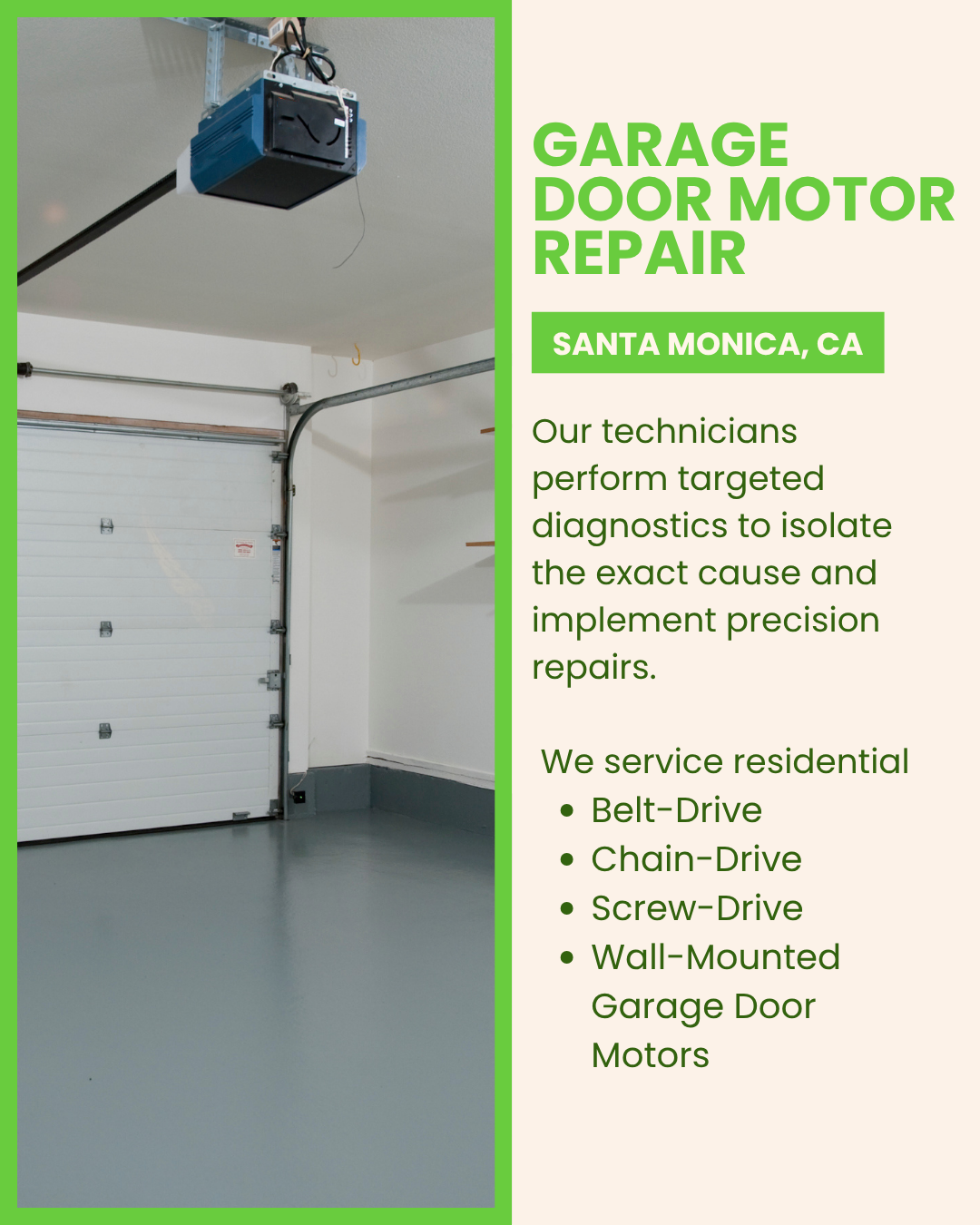
Beyond wiring, the control board inside the motor unit is the component most likely to have failed if power and wiring both check out. LiftMaster’s BGIC 5.0 platform — which is what’s shown in the post and one of the most widely installed systems across Santa Monica and the Westside — uses a logic board that can fail from power surges, heat accumulation in poorly ventilated garage ceilings, or simply end-of-life component failure after a decade of daily use. We carry replacement control boards for LiftMaster, Chamberlain, and other major platforms on our service vehicles, which means most control board failures are resolved on the first visit.
2. Motor Clicking or Humming Without Movement
This is the symptom that gets misread most frequently. The motor engages — you can hear it — but the door doesn’t move. The sound is either a rapid clicking as the motor tries to start and can’t, or a sustained hum as the motor runs without developing any rotational force. Both sounds feel like a dying motor. In most cases they’re not.
Clicking typically indicates a relay issue — the electrical switch that completes the circuit to the motor is making and breaking contact rather than holding cleanly. This is a control board component that can often be repaired without replacing the full board.
Humming without movement is almost always a failed capacitor. The capacitor provides the burst of starting torque that gets the motor spinning from a dead stop. Without it, the motor receives full power, tries to start, generates heat and a loud hum, and never actually turns. Capacitor failure is accelerated by heat — and Santa Monica garage ceilings, where motors are mounted, can reach temperatures that stress capacitors significantly during summer months. A capacitor replacement is one of the most cost-effective motor repairs we perform, and it produces an immediate, dramatic result: a door that was humming and going nowhere is suddenly running normally again.
One important note on this symptom: if the capacitor is replaced and the motor still hums without turning, the motor windings themselves may have burned out from the repeated heat cycles produced by the capacitor failure. This is why addressing a humming motor quickly matters — the longer it runs in the failed state, the higher the risk of secondary damage to the motor itself.
3. Door Reversing Unexpectedly
A garage door that starts closing and then reverses before reaching the floor — or starts opening and reverses partway up — is one of the more disruptive motor problems because it makes the door feel completely unreliable. The cause, though, is almost always traceable to one of three sources.
The first and most common is safety sensor misalignment or obstruction. The sensors sit near the floor on either side of the door opening and project an infrared beam across the doorway. If that beam is interrupted — by a leaf, a spider web, a child’s toy left near the door, or a sensor that’s been physically bumped out of alignment — the motor interprets it as an obstruction and reverses as a safety measure. The fix is sensor realignment and cleaning, which takes minutes.
The second cause is limit switch miscalibration. The limit switches tell the motor how far the door should travel in each direction. When they drift — which happens gradually from vibration over time — the motor may interpret its own normal travel as a stall condition and reverse. Recalibrating the limits is a standard part of any motor service visit.
The third cause is a mechanical resistance issue — the door is encountering friction at some point in its travel that the motor’s force sensing interprets as an obstruction. In Santa Monica, where salt air accelerates corrosion on tracks and rollers, a door that runs smoothly in moderate weather may encounter enough added friction on a cold morning or after a particularly humid coastal night to trigger the safety reverse. This is the version of unexpected reversal that’s actually telling you something useful about the mechanical condition of the door system.
4. Motor Running but Door Not Lifting
When the motor engages and runs through its full cycle but the door doesn’t move, the disconnect is almost always mechanical rather than electrical. The motor is doing its job. The problem is between the motor’s output and the door.
On belt-drive and chain-drive systems — the most common configurations in Santa Monica residential garages — the usual culprit is a broken or severely worn drive component. A snapped drive chain, a belt that’s jumped its track, or a trolley assembly that’s separated from the carriage all produce exactly this symptom. The motor runs. The chain or belt moves. The door doesn’t.
On direct-drive and wall-mount systems, which are increasingly common in Santa Monica remodels and new installations because of their quiet operation and space efficiency, the failure mode is typically in the motor’s coupling to the screw or rack system.
There’s also a scenario that doesn’t involve any component failure at all: the emergency release cord has been pulled — intentionally or accidentally — disconnecting the door from the trolley. This is the red cord hanging from the trolley carriage. If someone pulled it during a power outage and forgot to re-engage the door, the motor will run its complete cycle while the door sits completely still. It’s worth checking before calling for service, because re-engaging the door takes about thirty seconds.
5. Wi-Fi or Smart Motor Connection Problems
LiftMaster’s myQ platform — visible on the motor in the post — and similar smart motor systems from Chamberlain have become standard on new installations and popular upgrades across Santa Monica. They’re genuinely useful: remote monitoring, smartphone control, delivery access, and integration with smart home systems including Google Home and Amazon Alexa. When they lose connectivity, the motor still operates normally from the remote and wall button. But for households that have come to rely on smartphone access, a myQ disconnection is a genuine inconvenience.
Smart motor connectivity problems in Santa Monica follow predictable patterns. The most common is Wi-Fi network changes — a new router, a changed password, or a network band switch from 2.4GHz to 5GHz that the motor’s radio can’t connect to. LiftMaster’s myQ platform operates on 2.4GHz only, and a router upgrade that moves the primary network to 5GHz will silently disconnect every myQ device in the house.
The second common cause is a firmware update that’s reset the motor’s network credentials, which happens occasionally on the LiftMaster platform and requires a fresh setup through the myQ app. The third is a weak Wi-Fi signal at the motor’s location — garage ceilings at the far end of a property from the router are often in a signal dead zone, and a Wi-Fi extender positioned in the garage resolves the issue without any motor service at all.
We configure and troubleshoot myQ and smart motor connectivity as part of our standard motor service visits in Santa Monica. If the issue requires a hardware fix rather than a configuration change, we handle that on the same visit.
6. Safety Sensor Misalignment or Failure
Safety sensors are the most safety-critical component in a residential garage door system and the most frequently overlooked during routine maintenance. A sensor that’s working at reduced effectiveness is genuinely dangerous — and the challenge is that partial sensor failure is invisible until it fails to prevent an actual collision.
In Santa Monica’s coastal environment, sensor problems develop in specific ways. The sensor lenses — small plastic windows through which the infrared beam passes — accumulate a film of salt residue and dust over time that reduces beam intensity without producing a visible fault indicator. The sensor still shows a solid indicator light. It still passes a basic function test. Its effective detection range has been cut by half. Cleaning the lenses as part of a maintenance visit costs nothing and restores full performance.
Physical misalignment from vibration, from someone bumping the sensor bracket, or from the door’s repeated operation gradually shifting the bracket angle is the other common Santa Monica sensor issue. A sensor that’s pointed slightly off-axis will maintain its indicator light — the beam is still strong enough to reach the receiver — while failing to detect a partial obstruction in the doorway. Proper alignment verification requires checking the beam angle and signal strength, not just confirming the lights are on.
When sensors have degraded beyond adjustment — cracked housings from UV exposure, corroded wiring connections, or water intrusion into the sensor body — replacement is the right call. We carry compatible replacement sensors for LiftMaster, Chamberlain, Genie, and other major platforms on our service vehicles.
Garage Door Motor Repair Throughout Santa Monica, CA
WIN Garage Door & Gate Repair serves Santa Monica and the full Westside — including Venice, Mar Vista, West LA, Brentwood, Pacific Palisades, Culver City, Malibu, Beverly Hills, Encino, Van Nuys, Marina del Rey, Bel Air, Manhattan Beach, El Segundo, Hermosa Beach, Sawtelle, Westwood, Playa Vista, and Hawthorne.
Every motor repair starts with an honest diagnostic. We work on all major platforms including LiftMaster, Chamberlain, Genie, and Craftsman. No subcontractors. No upsells. No extra charge for emergencies. Free on-site estimates.
We also handle garage door repair, garage door spring replacement, garage door opener repair, gate repair, and gate motor repair on the same visit when both systems need attention.
Call (310) 818-7272 — Same-day garage door motor repair in Santa Monica, CA. We offer 10% military and veteran discount.
Our Services
Garage Doors: