

A garage door motor works quietly in the background every single day. Most Santa Monica homeowners never think about it until the door stops moving, makes an unfamiliar sound, or starts responding slower than it used to. At that point, the motor is usually past the early warning stage and already dealing with a problem that has been building for weeks or months. Understanding how garage door motors fail, which types are in use in most local homes, and when repair versus replacement is the right call can save you time, money, and the frustration of a door that will not open when you need it most.
How Garage Door Motors Take a Beating in Santa Monica
Santa Monica is a coastal city, and that geography creates specific wear patterns on mechanical systems that are not as common in drier inland areas. Salt air accelerates corrosion on metal components, moisture cycling causes rubber and plastic seals to degrade faster, and the combination of marine layer humidity in the mornings with warmer afternoons puts stress on electrical components over time. A garage door motor that might last 12 to 15 years in a dry climate often shows signs of wear closer to the 8 to 10 year mark in neighborhoods like Ocean Park, Sunset Park, and North of Montana where coastal conditions are most pronounced.
This does not mean motors fail prematurely in every case. It means that the conditions here demand more from the equipment, and homeowners who pay attention to early warning signs can usually get ahead of a full motor failure before it happens at an inconvenient time.
The Four Types of Garage Door Motors
Not all garage door motors work the same way, and knowing which type you have matters when diagnosing a problem or planning a replacement.
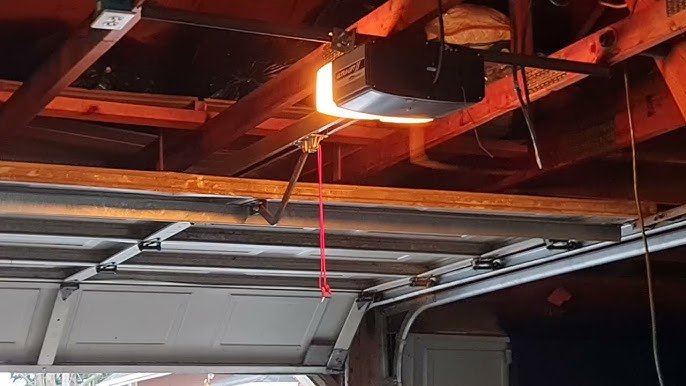
Belt-drive motors are the quietest option available and are common in Santa Monica homes where attached garages share a wall with living spaces. They use a rubber belt to move the trolley along the rail, which significantly reduces vibration and noise compared to older systems. The trade-off is that the belt itself can wear or crack over time, particularly in coastal humidity.
Chain-drive motors are the traditional workhorse of the industry. They are durable, widely serviceable, and generally less expensive to repair because parts are universally available. The downside is noise. Chain-drive systems are noticeably louder than belt-drive, which matters more in some homes than others depending on the garage placement.
Screw-drive motors use a threaded steel rod to move the trolley. They have fewer moving parts than chain or belt systems, which in theory means less maintenance. However, they are more sensitive to temperature and humidity changes, which makes them a less ideal fit for the coastal environment without proper lubrication and seasonal maintenance.
Wall-mounted motors, sometimes called jackshaft openers, attach directly to the wall beside the door rather than hanging from a ceiling track. Brands like LiftMaster produce well-regarded wall-mount systems that are popular in homes with high or vaulted garage ceilings where a traditional ceiling-mounted rail would not fit. They are compact, quiet, and offer a cleaner look, but they require specific hardware compatibility and are not as straightforward to service as conventional systems.
Warning Signs That Your Motor Needs Attention
Garage door motors rarely fail without giving some advance notice. The most common early sign is a change in response time. If your door used to start moving within a second of pressing the remote and now there is a noticeable delay, the motor is working harder than it should to initiate movement. This can point to a worn capacitor, a struggling circuit board, or a mechanical binding issue somewhere in the drive system.
Grinding or straining sounds during operation are another clear indicator. A healthy motor running a properly balanced door should be relatively smooth and consistent. Grinding typically means the drive mechanism is under stress, either from worn components inside the motor unit or from a door that is out of balance and placing uneven load on the opener.
A motor that runs but the door does not move is almost always a drive component failure rather than a motor burnout. The motor itself may be functioning, but the belt, chain, or drive rod has failed or disconnected. This is generally a more straightforward repair than a full motor replacement and is worth diagnosing before assuming the entire unit needs to go.
Intermittent operation is one of the more frustrating failure modes because it makes the problem hard to reproduce for a technician. The door works fine most of the time, then randomly fails to respond or reverses unexpectedly mid-cycle. Intermittent failures often trace back to the logic board or a sensor issue rather than a mechanical problem, and they tend to become more frequent as the underlying issue progresses.
Repair vs Replace: How to Think About the Decision
The general rule of thumb that experienced technicians use is straightforward. If the motor is under eight years old and the failure is a single identifiable component, repair is almost always the right call. Motors in this age range still have meaningful service life remaining, and replacing a capacitor, a gear set, or a drive component is a fraction of the cost of a new unit.
Once a motor crosses the ten to twelve year mark, the calculation starts to shift. At that age, the cost of a significant repair approaches or exceeds the cost of replacement, and a repaired older unit may simply develop the next failure point within a year or two. In those cases, replacement with a current-generation motor that includes smart connectivity, battery backup, and improved efficiency is often the better long-term investment.
For Santa Monica homes specifically, it is also worth considering whether the existing motor type still makes sense for the application. A homeowner who installed a chain-drive opener a decade ago and has since converted the garage into a living-adjacent space may find that the repair conversation is a natural moment to upgrade to a quieter belt-drive or wall-mount system.
What a Professional Diagnosis Actually Covers
When a WIN Garage Door technician arrives to evaluate a motor issue, the diagnostic process covers the full system rather than just the obvious symptom. That means checking door balance independently of the opener, testing the safety sensors and auto-reverse function, inspecting the drive components for wear, evaluating the logic board and wiring for corrosion or fault codes, and confirming that the remote and wall button are communicating correctly with the unit.
This matters because garage door problems are frequently misdiagnosed as motor failures when the actual cause is a door that is out of balance, a sensor that has shifted out of alignment, or a spring that is losing tension. Replacing a motor without addressing the underlying mechanical condition means the new unit inherits the same problems immediately.
A proper diagnosis takes the guesswork out and gives you a clear picture of what actually needs to be done and what it will cost before any work begins.
If your garage door motor is struggling, responding slowly, or has stopped working entirely, WIN Garage Door provides same-day service across Santa Monica and the Westside. Call (310) 818-7272 or visit wingaragedoorrepair.com to schedule a free on-site estimate.